Eastern Aesthetics Has No Shortage of Market—What It Lacks Is Usable Images
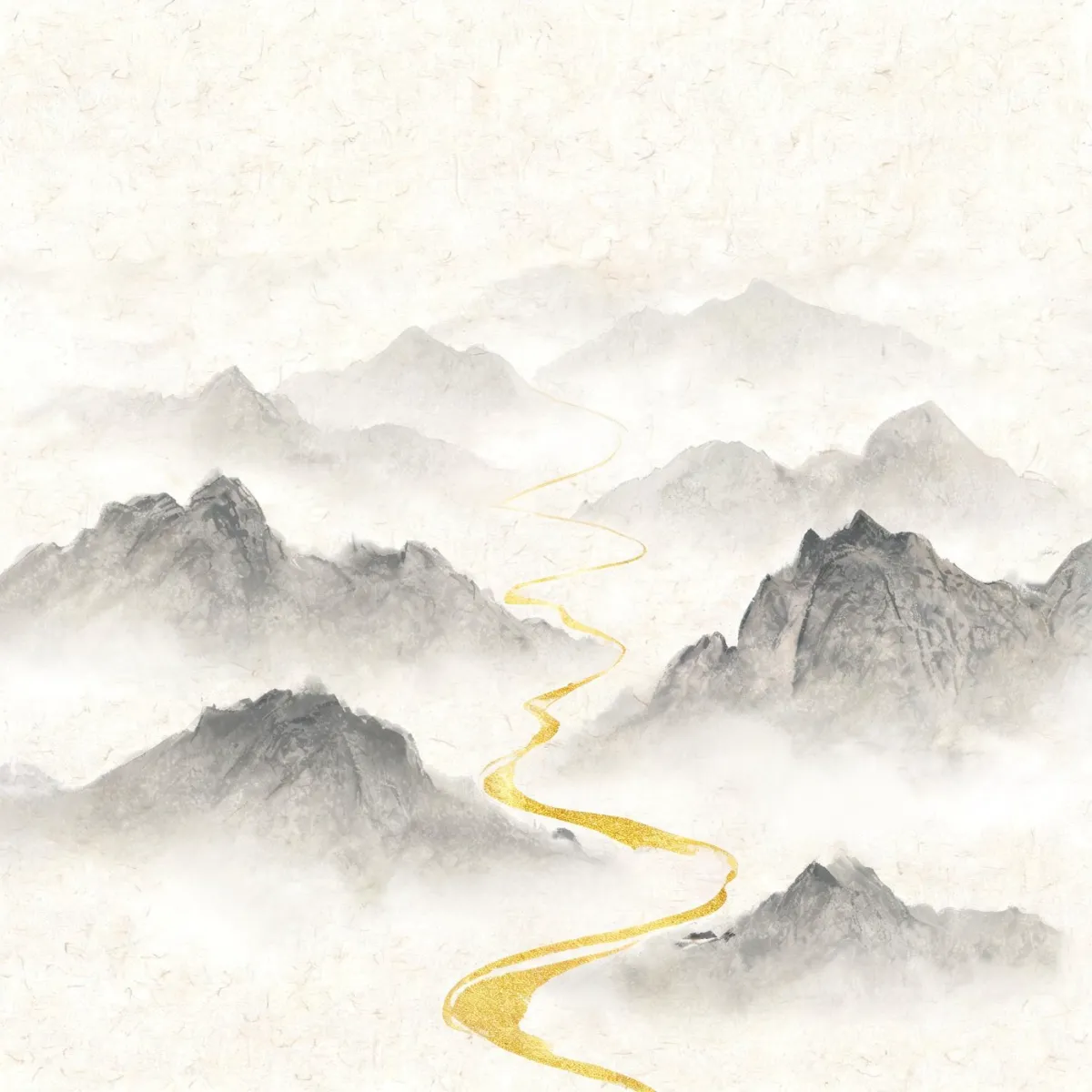
Tea, incense, liquor, skincare—when these categories want an "Eastern feel," finding images is extremely hard: they're either too rustic, too Japanese, or cheap ink-wash stock. This template uses rice paper texture and gold leaf to create a modern Eastern feel. 20 credits, 35 seconds.

The Western market's idea of "Eastern aesthetics" is very far from real Chinese ink wash. What you find in stock libraries is either red lanterns or calligraphy plus plum blossoms.
Real high-end feel comes from two things: large areas of negative space, and a little bit of gold.
The Four Keywords in the Prompt
"Traditional Chinese ink wash painting"—traditional Chinese ink wash. This phrasing is more accurate than "Chinese style" and brings out the real relationships of ink tone and density.
"misty mountains"—mountains in mist. A classic ink-wash subject: the mountain forms are cut by mist, creating natural negative space.
"golden foil accents"—gold leaf accents. Note that it's accents, not the main subject. This determines that the gold is small dots, not large areas.
"minimalist composition, rice paper texture"—minimalist composition + rice paper texture. The texture is the source of the ink-wash feel; without it, the image looks like a digital gradient.
"a winding river"—a winding river. It's the only leading line in the image, carrying the eye from the foreground to the distant mountains. Ink-wash composition values "flowing spirit"; this river is that flow.
Before You Start: Login and Credits
Log in. Open slloy.com, click "Log in" in the top right, enter your email, and enter the 6-digit verification code. The site only supports code-based login, with no password—just remember which email you used.
Credits. Generation is charged per run; this one is 20 credits (about $0.13 on the largest plan, up to $0.60 on the smallest). Your balance is in the account panel in the top right—open it to see it; if the balance is insufficient, the page will tell you directly and won't charge you for nothing.
Do you need to upload an image first for this one? No—the prompt is complete as written, so leave the upload box empty. Uploading an extra image actually makes it harder for the model to tell which one to follow.
What the interface looks like. After entering the generator, the left column from top to bottom is: image/video toggle, model (Seedream 5.0 for this one), prompt library (shows "preset loaded," the template has already filled in the words for you), prompt input box, style preset, aspect ratio, number of images, and at the very bottom the generate button—on long pages you need to scroll down a bit to see it. The right column is the preview area and recent works.
Steps: Two Steps
Step 1 — Use case "Make a cover" → "Guofeng · Ink Wash Gold Leaf Landscape" → Generate the same.
Step 2 — 20 credits, generate. This time 35 seconds, the fastest among style templates. Portrait 2:3 suits wall art and posters; landscape suits packaging flat layouts.
The Ink Is Great, the Gold Isn't Enough
The ink part is almost flawless: distant mountains pale, near mountains dark, the mist transition genuinely "dissolves" rather than blurs, the rice paper's fiber texture is visible, and the river's direction draws the eye in.
But the gold leaf is too pale and the gold lines too thin. Blown up to A3, those gold lines look flimsy and can't carry the word "high-end"—this is the most obvious weakness in testing.
How to Bring the Gold Back
Step 1 — Change the prompt. Replace "golden foil accents" with "thick gold leaf applied in broad patches, visible metallic sheen, catching the light"—emphasizing "large areas, thick application, metallic reflection." At the same time, dial "minimalist" down a notch to "restrained composition."
Step 2 — Add gold in post. In Photoshop, use a gold gradient overlay + layer blend mode (Overlay/Soft Light) for localized brightening; it's cheaper than regenerating repeatedly.
Step 3 — Change the use case. If the target is digital (web banners, social images), the current amount of gold is enough; if the target is print at A3 or larger, you must add more.
By the way: ink-wash negative space eats information. When using it for a poster, either put the title in the negative space (small type, light weight), or don't put any text at all and let the image carry it.
After the Image Comes Out: Download, Check, Rework
Don't click repeatedly while waiting. This one takes 35 seconds. The page will first show a placeholder block or blurred preview; the finished image appears only when progress completes. Clicking "Generate" again charges another 20 credits, and the two jobs will queue behind each other.
Download and naming. There's a download button below the finished image; what you get is the original at the generated size. When saving, put the use case and date in the filename (e.g. etsy-pin-2026-11-15-v1) so you don't have to dig through chat logs a week later.
Three checks. One, whether the main structure is distorted (bottle turned into a cylinder, wrong number of fingers, furniture floating off the ground); two, whether there are typos in any text in the image; three, whether there are dirty spots or extra props at the edges. If all three pass, you don't need to touch it again.
If you're not satisfied, change one sentence and run again. Don't rewrite the whole thing—rewriting means changing direction, and all your earlier judgment is wasted. Go back to the "How to Bring the Gold Back" section above, change only one sentence according to the fix described there, and spend another 20 credits on one more run. Failed jobs are automatically refunded, but they are not automatically retried—you need to click again yourself.
- 20 credits per image (about $0.13 on the largest plan, up to $0.60 on the smallest), 35 seconds this time
- A full set of packaging visuals with 4 versions = 80 credits
- For comparison: commissioning a Guofeng illustration costs $100–500, and an established artist has a one-month wait
- Good for: tea/incense/liquor packaging, Eastern-themed exhibition posters, book covers, holiday materials
Related posts
Cinematic rainy neon: an image with a story, no photographer needed
2026-11-15 · Tutorials · 5 min read
Need a product image before you've shot anything: studio-grade shot, 20 credits
2026-11-15 · Tutorials · 5 min read
Studio portrait: 85mm, soft light, real pores, no plastic look
2026-11-15 · Tutorials · 4 min read